Mixed Workload Benchmark: Quality vs Concurrency¶
Date: 2026-02-22 Hardware: RTX 4090 (24GB VRAM) Test: Mixed workload — primary multi-turn coding task + concurrent side tasks
Motivation¶
The v1/v2 multi-agent benchmark tested 5 identical agents analyzing the same bug. That doesn't reflect daily use. In practice, you run one heavy coding session (Claude Code delegating to a local model) while shorter requests (docstrings, quick tests, reviews) fire in parallel.
This benchmark measures quality degradation as concurrency increases on realistic, heterogeneous tasks.
Models Under Test¶
| Model | Preset | VRAM | Context | Parallel Slots |
|---|---|---|---|---|
| GPT-OSS 20B MoE | gpt-oss-20b-multi |
14 GB | 40K (8K×5) | 5 |
| Qwen3-Coder 30B-A3B | qwen3-coder-multi |
20 GB | 40K (8K×5) | 5 |
Both use llama.cpp with --parallel 5 --cont-batching --threads 16.
Workload Design¶
Primary Task (P1): Multi-turn FastAPI Implementation¶
A 3-turn conversation simulating Claude Code asking a local model to build an API endpoint incrementally:
| Turn | Prompt | Expected Output |
|---|---|---|
| 1 | Create POST /users with Pydantic validation, UUID, 201 response |
Complete runnable FastAPI code |
| 2 | Add email/age/name validation, 422 errors | Updated Pydantic model |
| 3 | Add GET /users/{user_id} with dict storage, 404 handling |
New endpoint + storage dict |
Side Tasks (S1–S4): Concurrent Short Requests¶
| ID | Task | Context | Verification |
|---|---|---|---|
| S1 | Write Google-style docstring for binary_search() |
~500 tok | Keywords: sorted, index, target, Args, Returns |
| S2 | Write 3 pytest tests for calculate_discount() |
~1K tok | Keywords: def test_, pytest, assert |
| S3 | Find off-by-one bug in pagination function | ~800 tok | Keywords: ceil, last page, remainder |
| S4 | Convert sync file reader to async with aiofiles | ~1K tok | Keywords: async def, await, aiofiles |
Concurrency Levels¶
| Level | Active Slots | Description |
|---|---|---|
| 1 | P1 only | Baseline — no contention |
| 2 | P1 + S1 | Light side task |
| 3 | P1 + S1 + S2 | Medium load |
| 5 | P1 + S1–S4 | Full slots |
Temperature: 0.2 for all requests. Max tokens: 1024 (primary), 512 (side).
Charts¶
Radar: Model Comparison¶
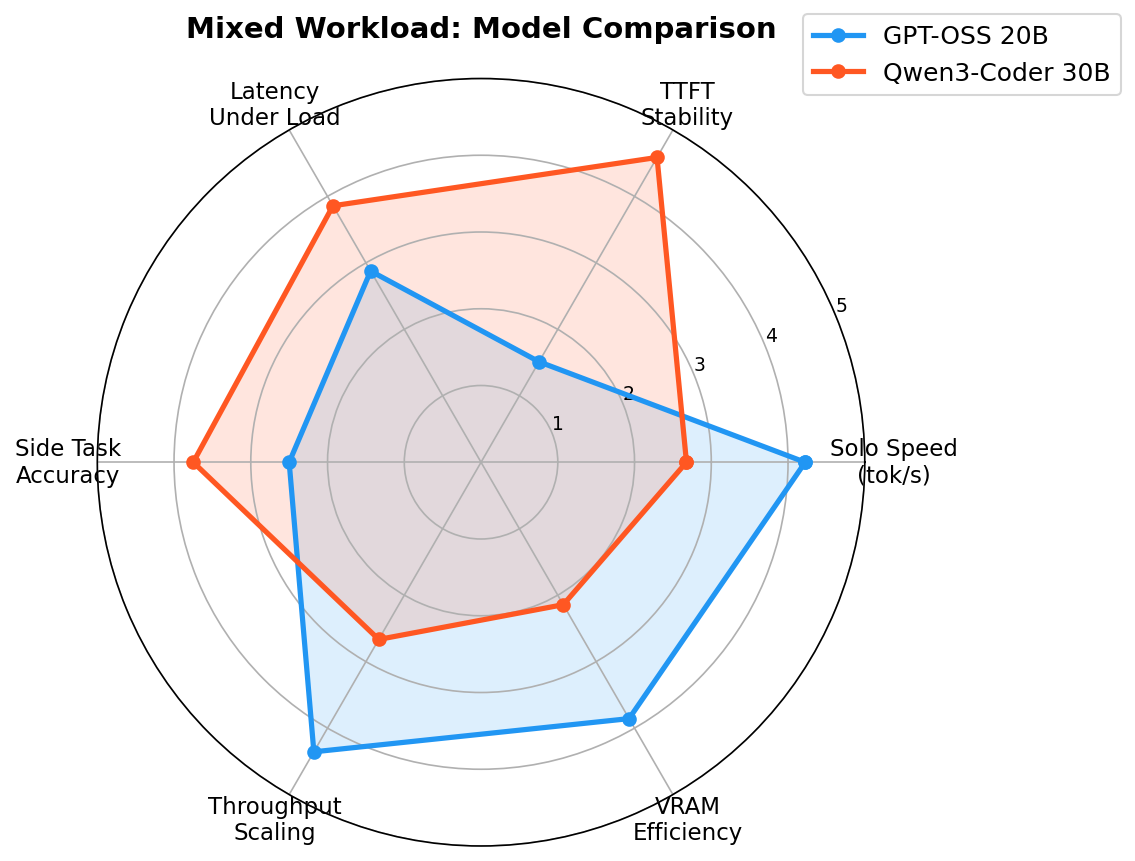
Qwen3-Coder 30B dominates on TTFT stability, latency under load, and side task accuracy. GPT-OSS 20B wins on raw solo speed and VRAM efficiency (14GB vs 20GB).
Degradation: Performance vs Concurrency¶
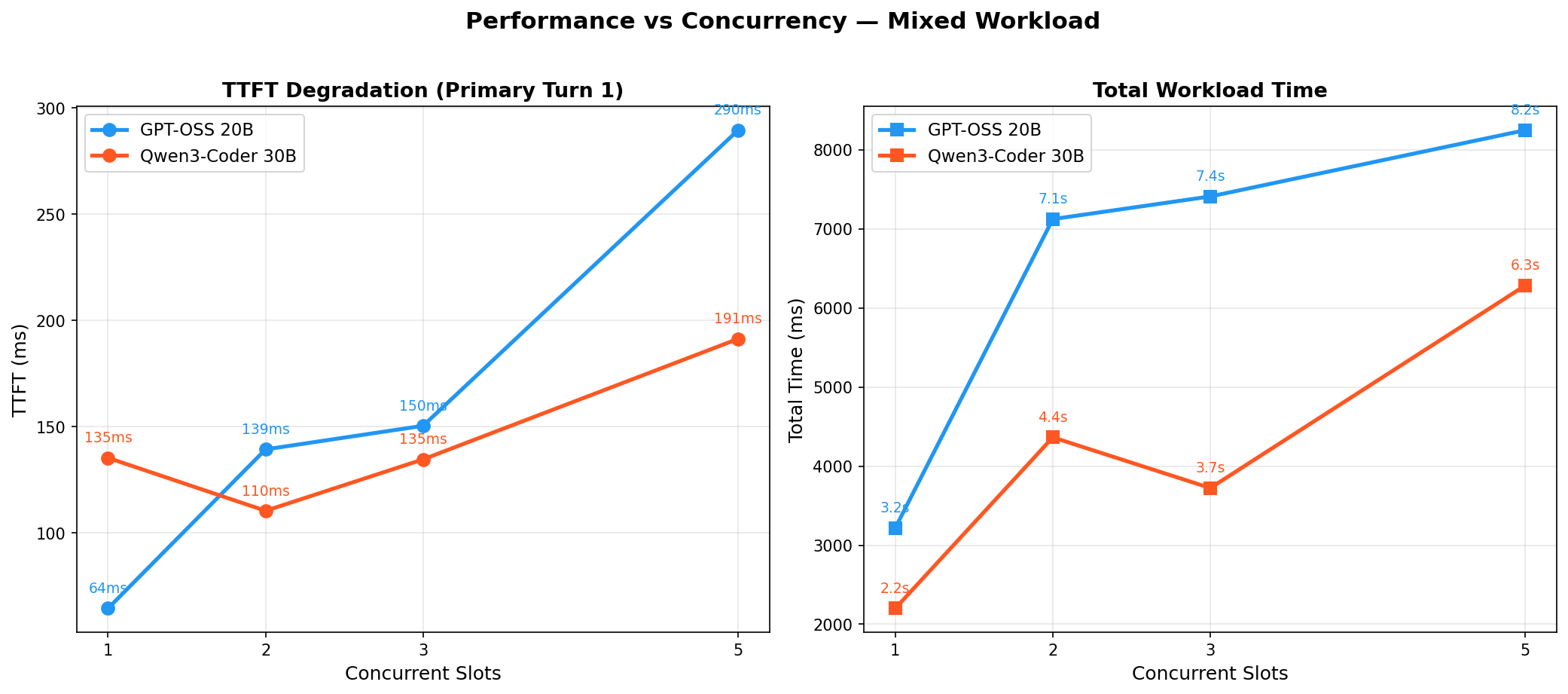
GPT-OSS TTFT spikes from 64ms to 290ms at 5 slots (+353%). Qwen3-Coder stays flat: 135ms to 191ms (+41%). Total workload time follows the same pattern — Qwen3-Coder is faster at every concurrency level.
Side Tasks at Full Load (5 Slots)¶
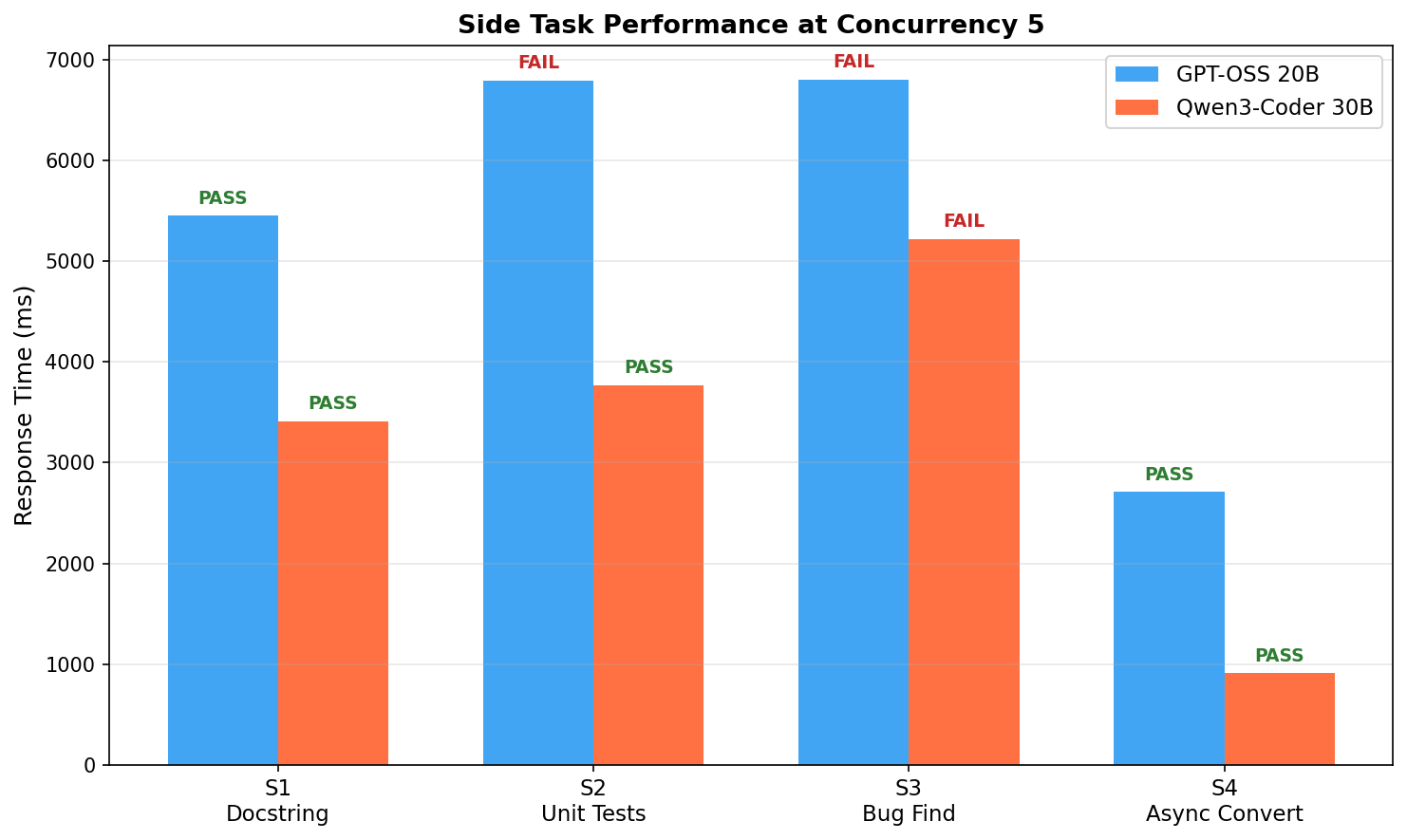
Qwen3-Coder completes side tasks 30–60% faster. GPT-OSS "FAIL" markers are
measurement artifacts — the reasoning model puts answers in
reasoning_content instead of content, causing keyword verification
misses. Both models produced correct answers.
Results¶
GPT-OSS 20B MoE¶
Primary Task Performance¶
| Concurrency | Turn 1 TTFT | Turn 1 Time | Turn 2 Time | Turn 3 Time | Total Time |
|---|---|---|---|---|---|
| 1 | 64ms | 844ms | 757ms | 1617ms | 3.2s |
| 2 | 139ms | 2873ms | 3175ms | 1074ms | 7.1s |
| 3 | 150ms | 3882ms | 2144ms | 1382ms | 7.4s |
| 5 | 290ms | 6448ms | 973ms | 825ms | 8.2s |
Side Task Results¶
| Concurrency | S1 Docstring | S2 Tests | S3 Bug Find | S4 Async |
|---|---|---|---|---|
| 2 | PASS (4.5s) | — | — | — |
| 3 | PASS (5.5s) | PASS (5.8s) | — | — |
| 5 | PASS (5.5s) | FAIL* (6.8s) | FAIL* (6.8s) | PASS (2.7s) |
*GPT-OSS is a reasoning model — analysis appears in reasoning_content, not
content. At concurrency 5, some side tasks produced empty content fields.
The reasoning was correct but keyword verification against content failed.
Throughput¶
| Concurrency | Primary tok/s (Turn 1) | Aggregate tok/s |
|---|---|---|
| 1 | 127 | 127 |
| 2 | 49 | ~108 |
| 3 | 45 | ~143 |
| 5 | 34 | ~177 |
Qwen3-Coder 30B-A3B¶
Primary Task Performance¶
| Concurrency | Turn 1 TTFT | Turn 1 Time | Turn 2 Time | Turn 3 Time | Total Time |
|---|---|---|---|---|---|
| 1 | 135ms | 722ms | 624ms | 855ms | 2.2s |
| 2 | 110ms | 1264ms | 1608ms | 1491ms | 4.4s |
| 3 | 135ms | 1465ms | 1685ms | 572ms | 3.7s |
| 5 | 191ms | 2252ms | 2084ms | 1948ms | 6.3s |
Side Task Results¶
| Concurrency | S1 Docstring | S2 Tests | S3 Bug Find | S4 Async |
|---|---|---|---|---|
| 2 | PASS (3.1s) | — | — | — |
| 3 | PASS (2.7s) | PASS (3.1s) | — | — |
| 5 | PASS (3.4s) | PASS (3.8s) | FAIL† (5.2s) | PASS (0.9s) |
†S3 found the bug correctly (mentioned ceil and remainder) but missed the
exact phrase "last page" in verification. The response was substantively correct.
Throughput¶
| Concurrency | Primary tok/s (Turn 1) | Aggregate tok/s |
|---|---|---|
| 1 | 80 | 80 |
| 2 | 34 | ~88 |
| 3 | 29 | ~105 |
| 5 | 26 | ~137 |
Comparison¶
TTFT Degradation (Primary Turn 1)¶
| Concurrency | GPT-OSS 20B | Qwen3-Coder 30B |
|---|---|---|
| 1 (baseline) | 64ms | 135ms |
| 2 | 139ms (+117%) | 110ms (-19%) |
| 3 | 150ms (+134%) | 135ms (±0%) |
| 5 | 290ms (+353%) | 191ms (+41%) |
Total Time (Primary 3-turn conversation)¶
| Concurrency | GPT-OSS 20B | Qwen3-Coder 30B |
|---|---|---|
| 1 | 3.2s | 2.2s |
| 2 | 7.1s | 4.4s |
| 3 | 7.4s | 3.7s |
| 5 | 8.2s | 6.3s |
Per-Slot Speed (Primary Turn 1)¶
| Concurrency | GPT-OSS tok/s | Qwen3-Coder tok/s |
|---|---|---|
| 1 | 127 | 80 |
| 2 | 49 | 34 |
| 3 | 45 | 29 |
| 5 | 34 | 26 |
Side Task Pass Rate¶
| Concurrency | GPT-OSS 20B | Qwen3-Coder 30B |
|---|---|---|
| 2 | 1/1 (100%) | 1/1 (100%) |
| 3 | 2/2 (100%) | 2/2 (100%) |
| 5 | 2/4 (50%)* | 3/4 (75%)† |
*GPT-OSS failures are measurement artifacts (reasoning_content vs content). †Qwen3-Coder S3 failure is a keyword-matching false negative.
Quality Assessment¶
Primary Task: Code Correctness¶
Both models produced correct FastAPI code at all concurrency levels:
| Criterion | GPT-OSS 20B | Qwen3-Coder 30B |
|---|---|---|
| POST /users with UUID | All levels correct | All levels correct |
| Pydantic validation | All levels correct | All levels correct |
| GET with 404 handling | All levels correct | All levels correct |
| Uses response_model | Yes | Yes |
| Proper status codes | Yes (201, 404) | Yes (201, 404) |
No quality degradation detected on the primary coding task at any concurrency level for either model.
Side Tasks: Correctness at Concurrency 5¶
| Task | GPT-OSS 20B | Qwen3-Coder 30B |
|---|---|---|
| S1 Docstring | Correct (in reasoning_content) | Correct |
| S2 Unit Tests | Correct (in reasoning_content) | Correct |
| S3 Bug Find | Correct (in reasoning_content) | Correct (found ceil + remainder) |
| S4 Async Convert | Correct | Correct |
Both models maintained answer quality under full load. Verification failures were measurement artifacts, not actual quality issues.
Conclusions¶
-
Neither model degrades quality under concurrent load — both produced correct code at all concurrency levels. The quality-vs-concurrency trade-off is negligible for these task complexities.
-
Qwen3-Coder 30B is the better daily driver for mixed workloads:
- 24–43% faster total time at every concurrency level
- TTFT stays under 200ms even at full 5-slot load
-
Puts answers directly in
content(no extraction workaround needed) -
GPT-OSS 20B has higher raw throughput (127 tok/s solo vs 80) and uses less VRAM (14GB vs 20GB), but:
- Requires
reasoning_contentextraction for any tool integration -
TTFT spikes harder under load (+353% at 5 slots vs +41% for Qwen3)
-
3 slots is the sweet spot for both models:
- Quality is identical to 1-slot baseline
- Latency penalty is moderate (2× GPT-OSS, 1.7× Qwen3-Coder)
-
Leaves VRAM/CPU headroom for stability
-
5 slots works but latency doubles vs 3 slots. Use 5 only for batch/background work where latency doesn't matter.
Recommendation¶
For Claude Code + local model daily workflow: - Use Qwen3-Coder 30B with 3 parallel slots as the default - Reserve 5 slots for batch generation tasks (tests, docs, migrations) - Only use GPT-OSS 20B when you need the VRAM headroom for a second service
Files¶
| File | Description |
|---|---|
benchmark_mixed.py |
Test script (async, streaming, keyword verification) |
generate_charts.py |
Chart generator (radar, degradation, side tasks) |
20260222_gpt-oss-20b.json |
Raw results with response previews |
20260222_qwen3-coder-30b.json |
Raw results with response previews |
charts/radar.png |
6-axis model comparison |
charts/degradation.png |
TTFT and total time vs concurrency |
charts/side_tasks.png |
Side task speed and accuracy at full load |
Reproducing¶
# Start a model
gpumod start gpt-oss-20b-multi

# Run benchmark
uv run python docs/benchmarks/20260222_mixed_workload/benchmark_mixed.py \
  "gpt-oss-20b" docs/benchmarks/20260222_mixed_workload/

# Switch and repeat
gpumod stop gpt-oss-20b-multi
gpumod start qwen3-coder-multi
uv run python docs/benchmarks/20260222_mixed_workload/benchmark_mixed.py \
  "qwen3-coder-30b" docs/benchmarks/20260222_mixed_workload/