Unified — Gemma 4 E2B (QAT Q4_K_XL) vs 26B-A4B-QAT-MTP — coding L1-L5 + AgentWorldBench (RTX 4090, b9784)
Date: 2026-06-25
Tickets: gpumod-kpmq (epic — extend the bench to AgentWorldBench + unified report); gpumod-kpmq.1 (AgentWorldBench eval harness), gpumod-kpmq.5 (standard E2B QAT Q4 preset)
Question: Two things at once. (1) Does the daily-driver gemma4-26b-a4b-qat-mtp-q4 keep its coding crown while we measure a new axis — world-modeling — on the same binary? (2) Is the tiny gemma4-e2b-qat-q4 (2.3 B, 2.4 GB) a viable cheap engine to drive the AgentWorldBench pipeline (harness dev + fine-tune-data generation in local-llm-lab) without paying for the 26 B?
This is the first bench to run both axes — the v2 coding suite (L1-L5) and AgentWorldBench world-modeling — for every model, in one report.
TL;DR
| Model | Coding | σ | Min/Max | 95% CI | TPS | AgentWorld | VRAM idle | GGUF | Verdict |
|---|---|---|---|---|---|---|---|---|---|
| gemma4-e2b-qat-q4 | 80.3 | 19.86 | 40/100 | [69.4, 91.3] | 252.9 | 28.6 | 2553 MB | 2.4 GB | Cheap AgentWorldBench engine — world-models within 2.5 pts of the 26 B at 1/8 the VRAM; the fine-tune target |
| gemma4-26b-a4b-qat-mtp-q4 | 99.3 | 2.58 | 90/100 | [97.9, 100.8] | 233.2 | 31.1 | 21323 MB | 13.3 GB | Keep as daily-driver — coding crown intact; world-modeling weak (scale is not the lever) |
Three headlines:
- The daily-driver keeps its coding crown — and is even the marginally-better world-modeler.
gemma4-26b-a4b-qat-mtp-q4scores 99.3 on the coding suite (L5 14/15) and 31.1 on AgentWorldBench. It dominates coding exactly as expected and edges the small model on world-modeling too, so adding the world-modeling axis gives no reason to change the daily-driver. - World-modeling is flat across an 11× scale gap. E2B-Q4 (2.3 B) scores 28.6; mtp-q4 (26 B) scores 31.1 — a 2.5-point spread despite ~11× the parameters and ~8× the VRAM. Out-of-the-box Gemma world-modeling is ~30/100 regardless of size. Scale buys coding (80.3 → 99.3), not world-modeling (28.6 → 31.1). This is the central evidence for the fine-tuning thesis: to make Gemma a world model you must fine-tune on AgentWorld-style trajectories, not scale up.
- E2B-Q4 is the right engine for the AgentWorldBench pipeline. At 2.4 GB / 2553 MB idle / 252.9 TPS, with a 128 K context that fits AgentWorldBench's largest prompts (full 14/14 coverage), it world-models within 2.5 points of the 26 B. For harness dev and fine-tune-data generation in
local-llm-labyou do not need the big model — and because the fine-tune target is itself E2B (cheap to train and serve), its coding score (80.3) is the retention floor the fine-tune must not erode.
Charts
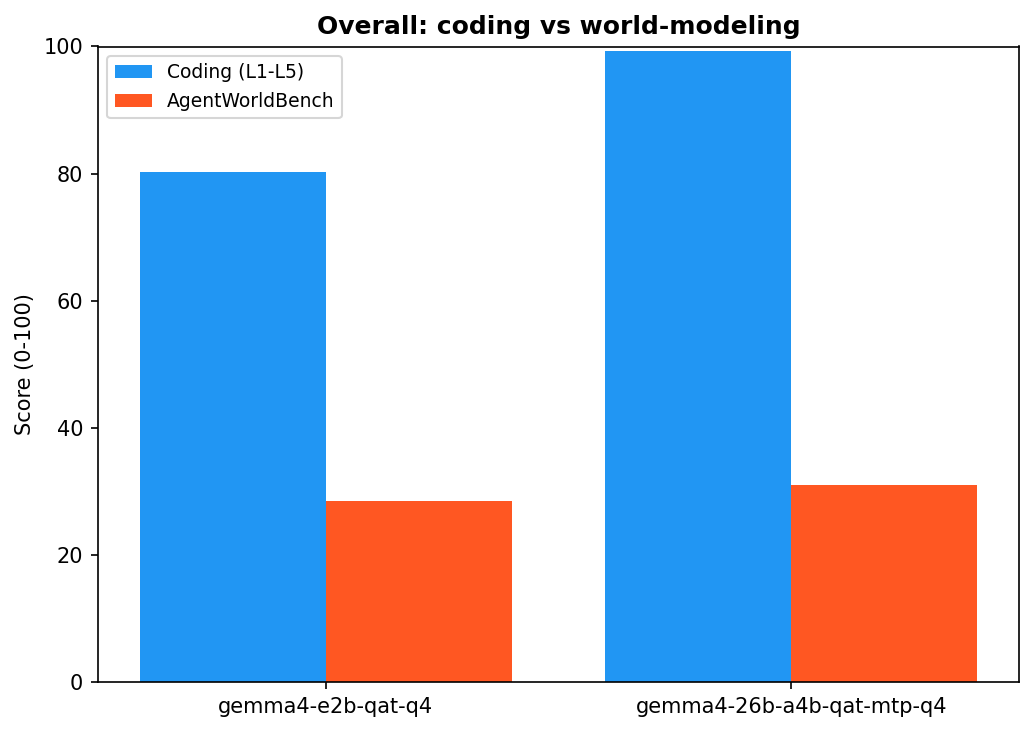
Overall: coding vs world-modeling — the gap is enormous on coding (80.3 vs 99.3) and negligible on world-modeling (28.6 vs 31.1).
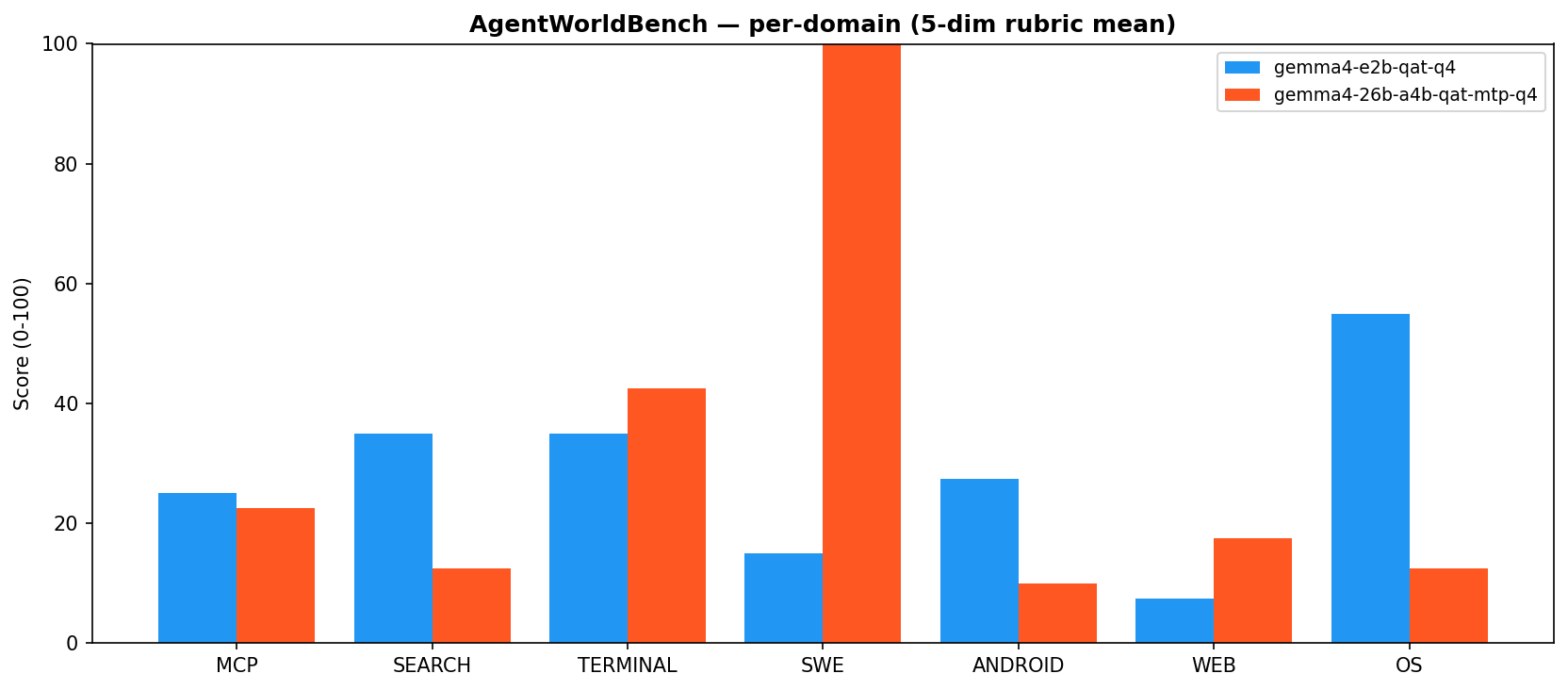
AgentWorldBench per-domain (0-100) — different profiles: mtp-q4 spikes on SWE (its coding strength bleeds into software-engineering trajectories) but is poor on os/search; E2B is flatter. Per-domain n=2, so read these as texture, not signal — the Overall is the robust number.
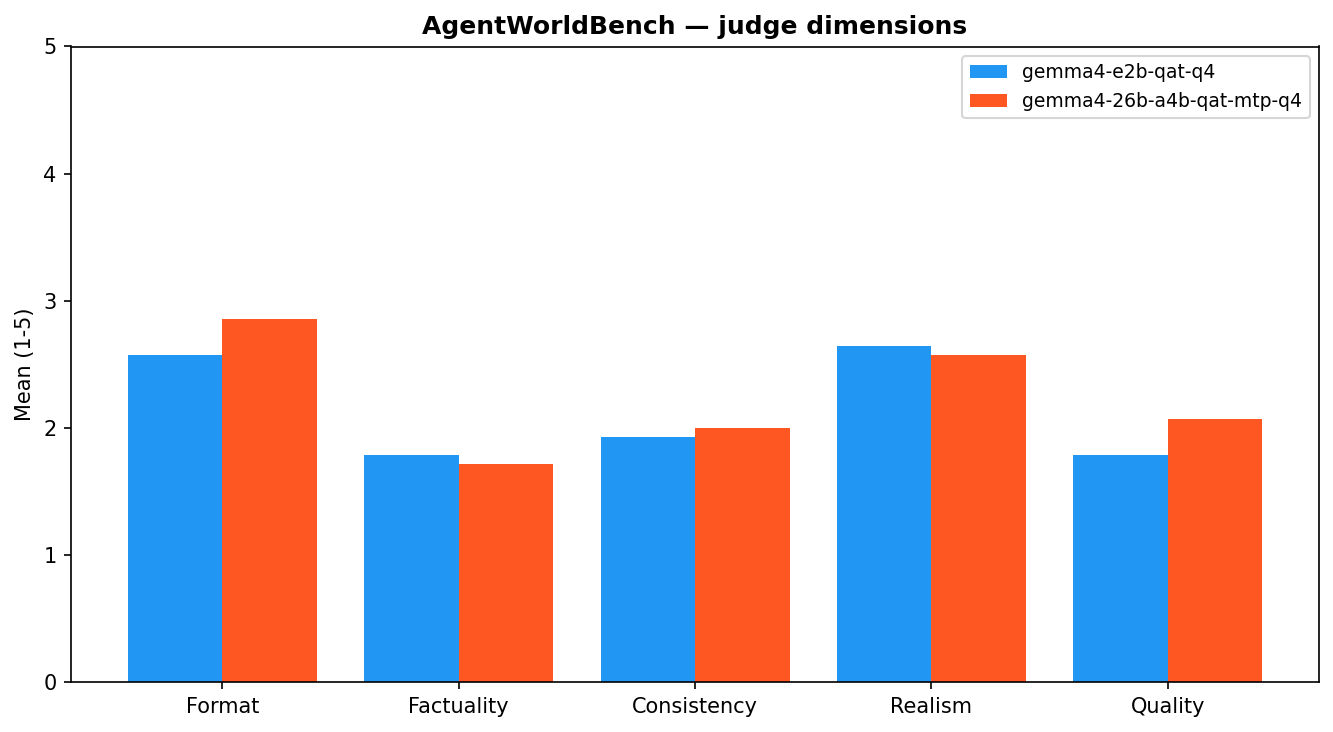
AgentWorldBench judge dimensions (1-5) — both models format plausibly (Format 2.6-2.9, Realism ~2.6) but get the facts wrong (Factuality ~1.75/5). Right shape, wrong content: the classic non-world-model failure.
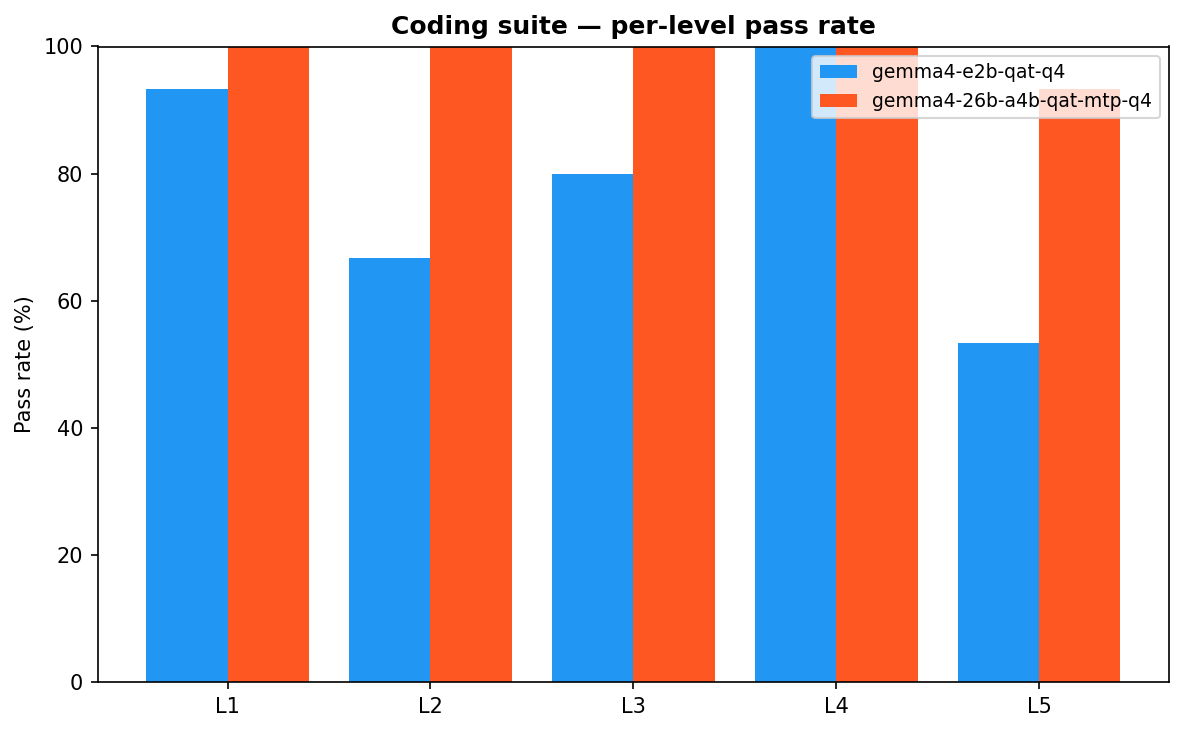
Coding suite per-level pass rate — mtp-q4 is near-perfect through L5; E2B holds L1/L4 but degrades on the hardest composition level (L5 8/15).
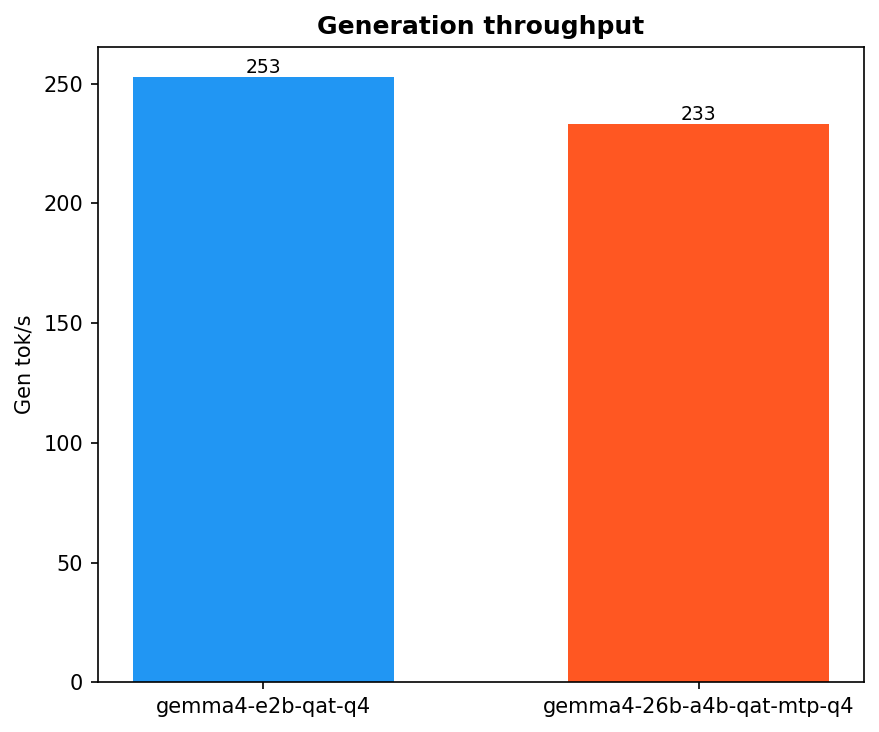
Generation throughput (TPS) — E2B-Q4 252.9 vs mtp-q4 233.2. The 2.3 B is faster, but MTP keeps the 26 B remarkably close.
Setup
| Component | Value |
|---|---|
| GPU | NVIDIA GeForce RTX 4090, 24564 MiB |
| Host RAM | 31 GiB |
| llama.cpp | version 9784 (8be759e6f) — both arms on this one binary |
| Stability defaults | GGML_CUDA_NO_PINNED=1 (template default); preflight RAM/VRAM checks |
| Isolation | gpumod mode switch blank before the run; one arm GPU-resident at a time (see run_bench.sh) |
Models tested
| Model | Source | Architecture | Quant | GGUF | Sampler | Port |
|---|---|---|---|---|---|---|
gemma4-e2b-qat-q4 |
unsloth/gemma-4-E2B-it-qat-GGUF |
dense E2B (~2.3 B effective) | QAT UD-Q4_K_XL | 2.4 GB | GEMMA_CODING | 7113 |
gemma4-26b-a4b-qat-mtp-q4 |
unsloth/gemma-4-26B-A4B-it-qat-GGUF |
MoE 26B / A4B + MTP | QAT UD-Q4_K_XL | 13.3 GB | GEMMA_CODING | 7110 |
E2B-Q4 is the standard (non-mobile) QAT tier — Unsloth's recommended quality point (98.16 % top-1). It is not the mobile repo's UD-Q2_K_XL (2-bit), which is degenerate on coding (rambles to the token cap). See presets/llm/gemma4-e2b-qat-q4.yaml and https://unsloth.ai/docs/models/gemma-4/qat.
Methodology
Two independent axes, each model started via gpumod service start, polled /health, run, then stopped + quiesced. Only one arm is GPU-resident at a time.
Axis 1 — coding suite (L1-L5)
v2 coding suite (scripts/run_qwen36_benchmark.py), 15 iterations/arm, 5 levels, PytestValidator:
| Level | Task | Points |
|---|---|---|
| L1 | Basic queue (add/get, FIFO) | 25 |
| L2 | Retry with exponential backoff | 25 |
| L3 | Priority scheduling | 25 |
| L4 | Find & fix concurrency bug | 15 |
| L5 | Compose Job + RetryPolicy + JobQueue (source-inspection) | 10 |
Axis 2 — AgentWorldBench (world-modeling)
scripts/run_agentworld_benchmark.py (harness in src/gpumod/benchmarks/agentworld/), the Qwen/AgentWorldBench dataset, 7 domains (mcp, search, terminal, swe, android, web, os), --sample 2 → 14 samples/arm. The eval is two-phase, and the two phases talk to different things:
- Generation (the model-under-test): an OpenAI client → the local gpumod-served endpoint (
http://localhost:<port>/v1). Given the action history + current action, the model predicts the next environment observation. - Judge:
claude -p --model opus(Claude Code CLI, subscription auth — no API key, no proxy). It scores the prediction against the ground-truth observation on five dimensions (Format, Factuality, Consistency, Realism, Quality, 1-5), mapped to 0-100 as(mean-1)/4×100.
Coding suite (L1-L5)
Per-level pass counts (of 15 iterations) and mean score.
| Model | L1 | L2 | L3 | L4 | L5 | Score |
|---|---|---|---|---|---|---|
| gemma4-e2b-qat-q4 | 14/15 | 10/15 | 12/15 | 15/15 | 8/15 | 80.3 |
| gemma4-26b-a4b-qat-mtp-q4 | 15/15 | 15/15 | 15/15 | 15/15 | 14/15 | 99.3 |
The 26 B is effectively saturated (one L5 miss in 75 level-attempts). The 2.3 B is respectable for its size — it holds L1 and L4 outright and only collapses on L5 (multi-component composition, the hardest level). The σ 19.86 reflects that L2/L3/L5 are coin-flips for it.
AgentWorldBench (world-modeling)
Five-dimensional reference-grounded judge, 0-100 per domain. n = 2 per domain (14 total) — treat per-domain cells as texture; the Overall column (n=14) is the robust signal.
| Model | MCP | SEARCH | TERMINAL | SWE | ANDROID | WEB | OS | Overall | Coverage |
|---|---|---|---|---|---|---|---|---|---|
| gemma4-e2b-qat-q4 | 25.0 | 35.0 | 35.0 | 15.0 | 27.5 | 7.5 | 55.0 | 28.6 | 14/14 |
| gemma4-26b-a4b-qat-mtp-q4 | 22.5 | 12.5 | 42.5 | 100.0 | 10.0 | 17.5 | 12.5 | 31.1 | 14/14 |
Judge dimensions (mean 1-5)
| Model | Format | Factuality | Consistency | Realism | Quality | Judge |
|---|---|---|---|---|---|---|
| gemma4-e2b-qat-q4 | 2.57 | 1.79 | 1.93 | 2.64 | 1.79 | opus |
| gemma4-26b-a4b-qat-mtp-q4 | 2.86 | 1.71 | 2.00 | 2.57 | 2.07 | opus |
Why the scores look like this
- The 2.5-point world-modeling gap across 11× scale is the whole story. If world-modeling tracked scale, the 26 B would pull far ahead, as it does on coding (+19 points). It doesn't (+2.5). Both Gemma variants are simply not trained as world models, and adding parameters does not conjure that capability — it has to be taught. That is precisely the
local-llm-labfine-tune thesis, now quantified. - The judge dimensions show the failure mode. Both models are decent on Format (2.6-2.9) and Realism (~2.6) — the predicted observations look like valid environment output — but weak on Factuality (~1.75) and Quality (~1.8-2.1): they hallucinate what the environment actually does next. Right shape, wrong content. A world model has to be factually grounded in the simulated environment's dynamics, which neither is out-of-box.
- mtp-q4's SWE=100 is its coding strength leaking in, not world-modeling. Its single standout domain is software-engineering trajectories — which read like code, where it is near-perfect. Strip SWE and its other six domains average ~19. So even the 26 B's small lead is mostly "SWE looks like code," not general world-modeling. (n=2/domain — do not over-read individual cells.)
- E2B's flatter profile (os 55, search/terminal 35) at the same overall reinforces the point: the two reach ~30 by different routes, neither by actually modeling environments well.
Methodology caveats
- E2B = standard QAT UD-Q4_K_XL (4-bit, ~2.3 B effective) — the recommended tier, not the degenerate 2-bit mobile variant.
- Judge =
claude -p(opus), Claude Code subscription, no API key, no proxy. Generation is the local gpumod endpoint; the two are independent. - AgentWorldBench n = 2/domain (14/arm). Enough for a stable Overall; per-domain cells are noisy. A larger
--samplewould tighten the per-domain breakdown (it would not move the headline: world-modeling is flat across scale). - Both axes on b9784, both arms re-run — no reuse of older-binary JSON. The comparison is binary-clean.
- VRAM is steady-state idle, not a true peak.
- Samplers: both use GEMMA_CODING (temp 1.0 / top_k 64) per Google's card — same family, so the cross-model comparison carries no sampler caveat here.
Recommendation
- Daily-driver: keep
gemma4-26b-a4b-qat-mtp-q4unchanged. 99.3 coding (L5 14/15) at 233 TPS; the new world-modeling axis gives no reason to swap. Its world-modeling (31.1) is weak, but so is every untuned Gemma's — that is a fine-tune problem, not a model-selection one. - AgentWorldBench pipeline (harness + fine-tune-data generation in
local-llm-lab): usegemma4-e2b-qat-q4. It world-models within 2.5 points of the 26 B at 1/8 the idle VRAM, runs at 252.9 TPS, and its 128 K context gives full 14/14 coverage. Generation does not need the big model. - The fine-tune is justified and its target is E2B. Both variants sit at ~30/100 world-modeling out-of-box and scale does not move it, so fine-tuning on AgentWorld trajectories is the only lever. Target E2B (cheap to train and serve). Its coding score here — 80.3 — is the retention floor: the distill/QLoRA run in
local-llm-labmust lift world-modeling without dropping below it (hence the mixed-objective / coding-replay plan in that note). This bench is the pre-fine-tune baseline to measure the run against.
Files
- run_bench.sh — 2-arm driver (both arms on b9784), then the unified-report generator
- result_gemma4-e2b-qat-q4.json, result_gemma4-26b-a4b-qat-mtp-q4.json — coding
- result_agentworld_gemma4-e2b-qat-q4.json, result_agentworld_gemma4-26b-a4b-qat-mtp-q4.json — AgentWorldBench (per-sample predictions + judge dimensions)
- charts/ — overall, agentworld_domains, agentworld_dimensions, coding_levels, tps
Related
- gpumod-kpmq (epic) — extend the bench to AgentWorldBench + unified report; gpumod-kpmq.1 (eval harness), gpumod-kpmq.5 (E2B QAT Q4 preset)
- docs/benchmarks/20260625_agentworld_35b_a3b/README.md — the coding-only AgentWorld bench; format + methodology reference for this report
local-llm-lab/.notes/gemma4-agentworld-distill-finetune.md— the fine-tune plan this baseline feeds (Claudeclaude -pdata-gen + Unsloth QLoRA, coding-retention objective)